The science is in, the appointments are booked, and the soul, frankly, is tired. There is only one prescription left worth filling.
There is a particular shade of exhaustion that has nothing to do with sleep. You recognize it in the slow blink at the laptop, the cup of coffee gone cold beside three open Slack threads, the Sunday-night dread that arrives, now, somewhere around Thursday. We have given it a clinical name — burnout — and a clinical definition, and a clinical place in the World Health Organization’s International Classification of Diseases, where it lives, very officially, as an occupational phenomenon. None of which has made a single one of us feel better.
What might? The answer, increasingly, is not another wellness app, another sound bath at lunch, another HR memo about “well-being.” It is, with all the inconvenient simplicity of the truly correct things, a plane ticket. Or a train. Or a winding road into somewhere you have never been.
Travel, it turns out, is medicine. And like the best medicine, it works whether you believe in it or not.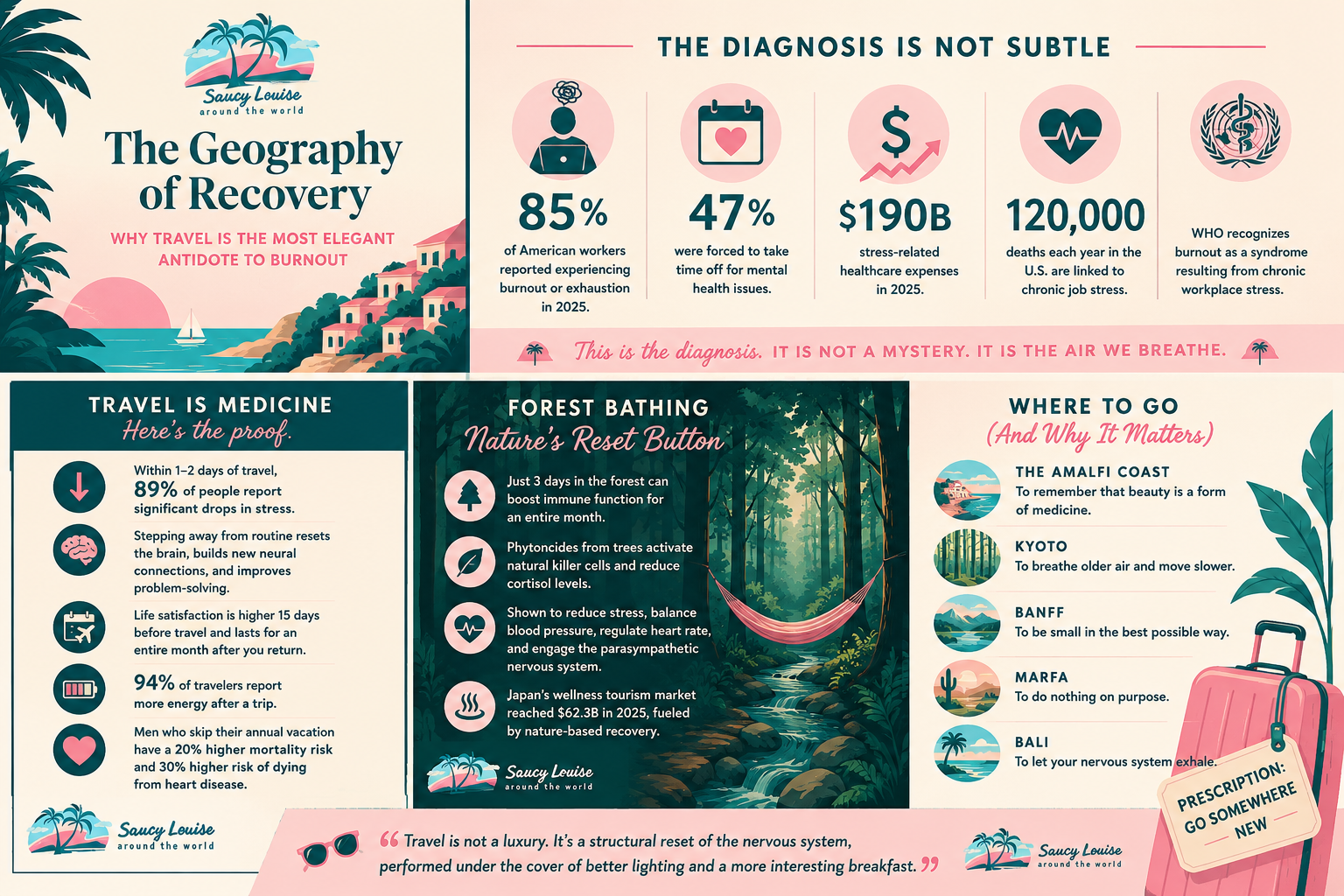
The Diagnosis Is Not Subtle
Let us begin, as Vogue always begins, with the facts — because facts, deployed beautifully, are their own kind of seduction.
In 2025, nearly 85% of American workers reported experiencing burnout or exhaustion, and 47% were forced to take time off for mental health issues. The economic theater of this collapse is staggering: stress-related healthcare expenses in 2025 alone totaled roughly $190 billion, and chronic job stress contributes to around 120,000 deaths each year in the United States. The numbers march on with the grim inevitability of a Joan Didion sentence. The WHO formally added burnout to its 11th Revision of the International Classification of Diseases, describing it as a syndrome resulting from chronic workplace stress that has not been successfully managed — characterized by feelings of energy depletion and exhaustion.
The young are not, as the discourse sometimes suggests, particularly delicate. They are simply arriving first to a fire that was already lit. Nearly half of young workers aged 18-29 report that their job has negatively affected their mental health, and the rates of emotional depletion among women, frontline workers, and the LGBTQ+ community remain stubbornly, unforgivably high.
This is the diagnosis. It is not a mystery. It is the air we breathe.
The Prescription Reads Like a Travel Brochure
Here is where the literature becomes almost embarrassingly romantic. Researchers — sober people, in lab coats, with grant applications to file — have spent decades discovering, again and again, what your grandmother could have told you in twelve words: go somewhere else for a while.
The health benefits of vacation include reducing cortisol levels, releasing mood-boosting hormones, and improving overall brain function. Cortisol — the body’s primary stress hormone, the chemical signature of your inbox — falls measurably when we leave our routine behind. Within just one or two days of travel, 89% of people report significant drops in stress. That is not anecdote. That is data with a passport.
The Cleveland Clinic puts it plainly: when we step away from routine, our brains reset. Every new activity forges new neural connections, helping us see things from different perspectives and improving problem-solving — while reducing the stress hormones that have been quietly poisoning the well. Travel, in other words, is not a luxury we afford ourselves. It is a structural reset of the nervous system, performed under the cover of better lighting and a more interesting breakfast.
Even more bewitching: the afterglow. A South Korean study found that life satisfaction is meaningfully higher 15 days before travel — anticipation, it seems, is its own drug — and continues to run higher for an entire month after the traveler returns home. A Harvard study of 400 travelers found that 94% reported more energy upon returning from a trip. And in a finding that should sit, framed, on the desk of every executive who has not used their PTO since 2019: men who skip their annual vacation have a 20% higher overall mortality risk, and a nearly 30% higher risk of dying from heart disease. Skip the trip; the universe collects the difference.
Forest Bathing, or: The Quiet Genius of the Japanese
If there is a single travel concept this decade has crowned its darling, it is shinrin-yoku — forest bathing. Coined in 1982 by Japan’s then-Forestry Agency chief, Tomohide Akiyama, the practice involves taking in the forest through all five senses as a form of relaxation, and it has migrated from cultural ritual to clinical intervention with extraordinary speed.
Researchers now suggest that just three days of forest bathing can boost immune function for an entire month, owing in part to phytoncides — the volatile organic compounds released by trees — which activate the body’s natural killer cells. Forest bathing has been shown to reduce stress, balance blood pressure, regulate the heart rate, and engage the parasympathetic nervous system, the body’s restorative gear. The wellness tourism market in Japan alone reached $62.3 billion in 2025, fueled by exactly this kind of nature-based recovery — onsen hot springs, Zen meditation retreats, and forest immersion programs scientifically validated for cortisol reduction.
The implication is not merely that nature is nice. It is that the body, in its ancient wisdom, recognizes a forest as home in a way it has never quite recognized an open-plan office.
Where to Go, and Why It Matters
The advertorial impulse here is to hand you a list — and so, generously, here it is. But understand: the destination matters less than the leaving.
Go to the Amalfi Coast in shoulder season, when the lemon groves have outlasted the crowds and the light goes copper at five. Go to Kyoto in autumn, where shinrin-yoku is not a hashtag but a centuries-old civic practice and the maples turn the color of a good Burgundy. Go to the Scottish Highlands for the silence — a kind of silence Americans have, frankly, forgotten the texture of. Go to a small coastal town in Portugal, the kind with one good bakery and no Wi-Fi to speak of, and stay for ten days. Go to Oaxaca for the food and the mezcal and the way the city handles sorrow with such grace it begins to look like joy.
Go, if you must, somewhere closer. The research is clear: travel for pleasure, to places you actually want to go, produces the greatest mental health benefits — and trips do not need to be expensive or exotic to deliver them. A weekend in a cabin two hours from your apartment will move your cortisol the way a board meeting will not.
On Doing It Properly
A word on method, because this is Vogue and method matters.
Travel mindfully. Resist the urge to industrialize the itinerary. The point is not to consume the destination but to be metabolized by it. Leave the phone in the hotel safe for at least an afternoon — what the wellness set calls a digital detox, and what the rest of us might call simply remembering how to be a person. Walk. Eat slowly. Talk to strangers, when you can stand to. A 2020 study published in Nature found that people who experience more changes in scenery day-to-day tend to be measurably happier — variety, it turns out, is not only the spice of life but its antidepressant.
And then: come home. Come home and let the afterglow do its quiet, unremarkable work. The inbox will still be there, because the inbox is forever. But something in you, something that had been clenched for months, will have loosened. You will sleep differently. You will laugh, possibly, at something genuinely small. You will sit in your own kitchen and feel, for a moment, as though you have visited yourself.
Burnout is a problem of geography as much as it is one of biology. The good news, the very good news, is that geography is the easiest variable to change. Book the trip. The research is on your side, and so, in the end, is the world.
Resources:
https://pmc.ncbi.nlm.nih.gov/articles/PMC10387774/
https://scholar.google.com/citations?user=CaGnZOUAAAAJ&hl=en
The most stylish thing you can do this year is leave. Go on, then.
Kitty Ramirez is a passionate writer, explorer, and advocate for the preservation and understanding of indigenous cultures and traditional plant medicines. As the author of the blog, Kitty shares her knowledge and experiences from her many journeys across the globe, connecting her readers with the wisdom and healing practices of ancient cultures. Born and raised in a multicultural family, Kitty developed a deep curiosity about the world and its diverse cultures at a young age. Her adventurous spirit led her to embark on a life of travel, exploring the far corners of the Earth in search of transformative experiences and a deeper understanding of human connection. Throughout her travels, Kitty has had the opportunity to immerse herself in various indigenous communities, learning from their rich traditions and sacred healing practices. Her encounters with plant medicines, such as Ayahuasca, Sananga, and Rapé, have been particularly life-changing, inspiring her to share the power of these ancient remedies with a broader audience.